Chapter 4: What He Told Dad
Ellen filed on Thursday at 9:02 a.m. By noon, the title company had put the closing on hold.
By four, Doug was standing in the dining room at 418 Larkin Street with a copy of my claim in his fist.
He’d flown back in for the closing. He still had the airport on him, the stale coffee and the rolling suitcase he’d left on the porch. He slapped the papers on the table so hard the fruit bowl jumped.
“Two hundred and twenty-one thousand dollars?”
“Four hundred,” I said. “Two hundred twenty-one thousand, four hundred.”
“You billed Dad. You actually billed our father for being his daughter.”
“Dad billed Dad. Read the agreement. He signed it.”
“He’d had a stroke!”
“Three months before. He was doing the crossword in pen.” I slid the spreadsheet across to him. “Ramp. Bathroom. Roof. Every receipt’s in a shoebox at my lawyer’s office if you want to count them.”
He didn’t look at it. He looked at me like he’d never seen me before, and maybe he hadn’t. For five years I’d been the voice on speakerphone saying he’s fine, he’s tired, he says hi.
“I have a buyer,” he said. “A cash buyer. Do you know what happens if this falls through?”
“You keep a house in Toledo you don’t want.”
“I lose the business.”
I stopped.
He sat down hard in Dad’s chair, the one at the head of the table nobody had used since May. All the Scottsdale went out of him at once.
“The landscaping company,” he said. “It’s been bleeding for two years. I’ve got a hundred and eighty thousand on a credit line with my house as collateral. Kristen doesn’t know how bad it is. The bank called the loan in November.”
“November,” I said.
“Yeah.”
“So in December you came home alone.”
He didn’t answer.
“You took Dad out in nine-degree weather for four hours,” I said. “You didn’t go to see the lights, did you?”
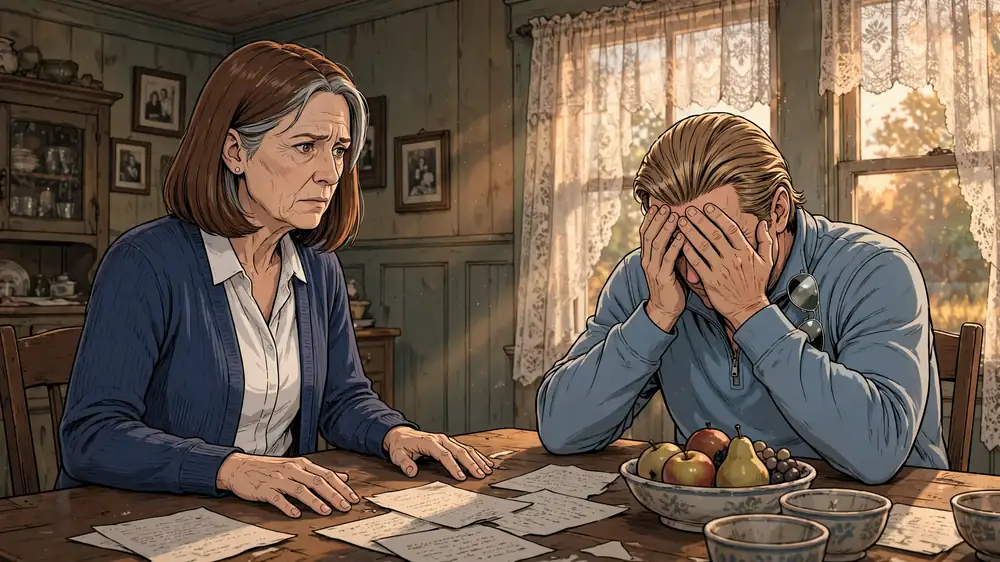
“I didn’t make him do anything.” His voice cracked. “I told him the truth. I told him I was going to lose the house. That the boys would have to change schools. That his grandsons, the only Brennans left, were going to be living in an apartment.”
“You told him the name was in trouble.”
“I told him the truth, Maggie!”
“You told a man with brain damage a story he couldn’t check, and then you drove him to a lawyer you’d already called.”
Doug put his face in his hands.
I wanted to feel triumphant. I didn’t. I felt sick, because I was thinking about a night two winters ago when Dad wet the bed for the third time in a week and I said something to him I’ve never told anyone. I said, I gave up my whole life for this. He turned his face to the wall. In the morning he apologized to me.
Maybe he’d thought about that night when Doug asked him. Maybe he’d thought I’d be relieved to get my life back. Maybe I was the one who’d taught him I was keeping score.
“I’m going to contest it,” Doug said into his hands.
“Contest what?”
“Your agreement. Dad wasn’t competent in 2021. Or you forged it. Somebody at the bank was your friend. Something.”
I let that sit for a second.
“Doug,” I said. “If Dad wasn’t competent in June of 2021, three months after his first stroke, what was he on December 27th, four years and a lot of little strokes later, after you’d kept him out in the cold for four hours?”
He lifted his head. The color went out of his face in stages, like a tide.
He’d just argued his own will into the trash, and we both knew it.
My phone buzzed on the table between us. Ellen.
I almost let it ring. Then I picked it up.
“Maggie.” Her voice was different. Careful. “I called the bank this afternoon. The notary on your agreement still works there. Ruth Kaminski. She keeps a journal of every signing, which is the law, and she let me read it.”
“Okay.”
“There’s a second entry for your father. Not from 2021.”
I looked at Doug. He was watching my face.
“When?” I said.
“January 9th. This year. Two weeks after the new will.” Ellen paused. “Maggie, your father came back in January. Alone. And he left a sealed letter with Ruth, addressed to you.”