
Chapter 3: The Blue Folder
The notice came eight days after the funeral. It was taped to the front door, right above the ramp I’d paid for.
NOTICE TO VACATE. A law firm letterhead from Phoenix. You are hereby notified that the owner of the premises requires you to vacate within thirty (30) days.
The owner of the premises.
I read it twice standing on the ramp, then went inside, opened the hall closet, and took down the blue folder.
It was thinner than I remembered. Three pages, stapled, with a gold notary seal pressed into the last one.
PERSONAL CARE AGREEMENT.
I sat down on the stairs and read it, and my hands started to sweat.
Dad had agreed to pay me two thousand eight hundred dollars a month for “personal care services, supervision and household management,” starting the month of his stroke. He’d agreed to reimburse every documented dollar I spent on his medical needs and the house. And because he knew his pension couldn’t cover it, there was one more paragraph, in plain English that sounded exactly like him:
All unpaid amounts under this agreement shall accrue and shall be paid from my estate before any distribution to any heir.
Before any distribution. To any heir.
He’d signed it June 14th, the summer after the first stroke, when he was doing crossword puzzles in pen again. The notary had signed it. I had signed it, under him, without reading a word.
I got the shoebox down too.
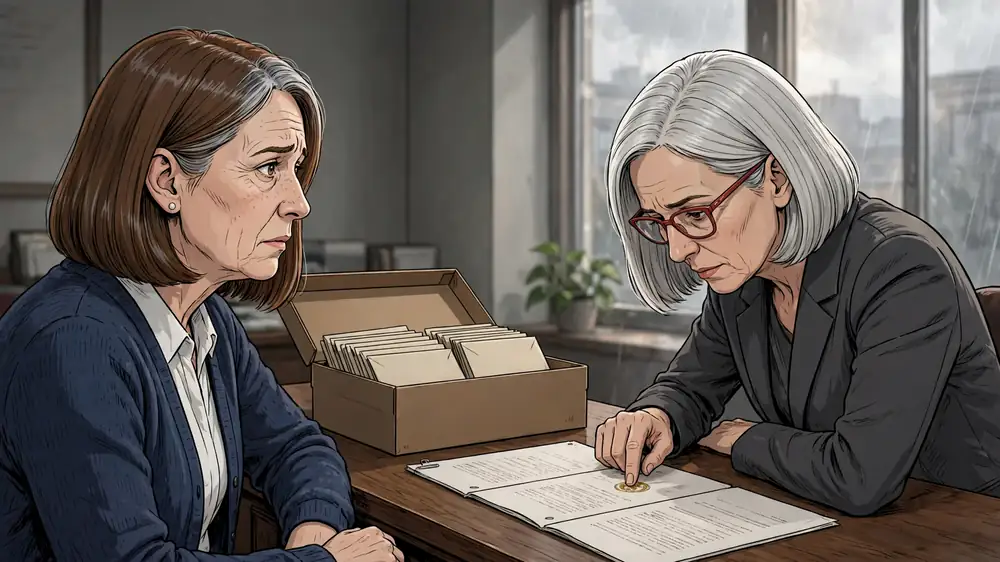
Ellen Sato had a corner office over a bank on Monroe Street and a reputation, according to my old coworker, for “making people cry in depositions and then sending them a nice card.” She was fifty-eight, with a sleek silver bob and red reading glasses, and she read the agreement twice without saying anything.
Then she opened the shoebox.
I’d done what billing people do. Every receipt was flattened, dated and sorted into envelopes by year. On top was a spreadsheet I’d made at two in the morning in the first year and kept up ever since, out of nothing but nerves.
Ramp, six thousand two hundred. Bathroom, fourteen thousand eight hundred. Roof, after the ice storm, eleven thousand four hundred. Five years of copays, a hospital bed, a lift chair, the stair rail, the furnace.
“Fifty-three thousand, four hundred in expenses,” Ellen said. “And sixty months of care at twenty-eight hundred.”
“A hundred and sixty-eight thousand,” I said. I didn’t need a calculator. “Two hundred twenty-one thousand, four hundred total.”
“Did he ever pay you any of it?”
“No. I lived on my savings.”
Ellen took off her glasses. “Maggie, your father was smarter than both of us.”
“I don’t feel smart. I feel like I’m sending my dead father a bill.”
“You’re not sending it to him. He sent it. He signed it, he had it notarized, and he told you to keep the receipts.” She tapped the folder. “Here’s what happens. We file a creditor’s claim against his estate in probate court. Then we record a notice against the house with the county. As long as your claim is unpaid, no title company in Ohio is going to close a sale on that property.”
“So Doug can’t sell it.”
“Doug can sell it. He just has to pay you first. In full.”
I thought about the house. It might sell for two-ninety. Take out my two-twenty-one, the realtor, the estate costs, the taxes.
“He’d walk away with almost nothing,” I said.
“He’d walk away with what’s left after his father’s debts are paid,” Ellen said. “That’s how estates work. It’s not revenge. It’s arithmetic.”
I wanted to believe her. Part of me still heard Dad saying Margaret will understand, and part of me heard every aunt at every Easter dinner telling me family doesn’t keep score.
“File it,” I said.
Ellen pulled her keyboard over. “I’ll do it Thursday morning. First, let me look at the property records, so I know what we’re dealing with.”
She typed. She clicked. She stopped.
Then she turned her monitor toward me.
It was a real estate listing. Our house, photographed on a sunny day I didn’t remember, the ramp cropped out of every picture. Charming brick colonial. Original hardwood. Investor special.
Across the top, in a green banner, was one word.
PENDING.
“He didn’t wait thirty days,” Ellen said quietly. “He already accepted a cash offer. They close Friday.”