Chapter 1: The House Goes Where the Name Goes
“The house at 418 Larkin Street, and all its contents, I leave to my son, Douglas Francis Brennan.”
Harold Fisk read it in the same flat voice he’d used for the funeral home invoice. He didn’t look up. He turned the page with one finger, like the paper might bite.
I was sure I’d heard him wrong.
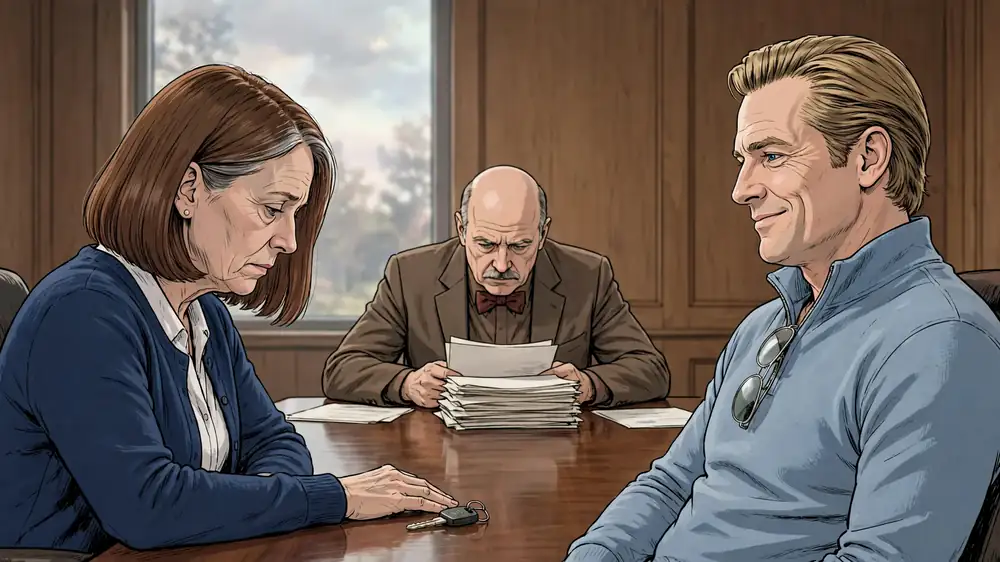
Across the conference table, my brother leaned back in his chair. Doug had flown in from Scottsdale for the funeral with a golf tan and a new quarter-zip, and he’d been checking his phone under the table all morning. He wasn’t checking it now.
“I’m sorry,” I said. “Harold. Read that again.”
“Maggie—”
“Read it again.”
He did. The words didn’t change. Then he cleared his throat and kept going, because that was his job.
“To my daughter, Margaret Anne Brennan, I leave my 2004 Buick LeSabre and the sum of five thousand dollars.”
Five thousand dollars.
I did the math without meaning to. It’s a habit from eleven years in hospital billing. Five years. Sixty months. Eighteen hundred and some days of changing sheets at two in the morning, of crushing pills into applesauce, of learning which grunt meant pain and which meant the remote fell. Five thousand dollars came out to about two dollars and seventy cents a day.
The Buick had a cracked windshield and a heater that only worked on high.
“There’s a statement of intent,” Harold said. “Your father asked that I read it aloud.”
“Of course he did,” Doug murmured.
Harold adjusted his glasses. “My son carries the Brennan name. The house goes where the name goes. Margaret will understand.“
I didn’t understand.
I sat there in my funeral clothes, the navy cardigan Dad always said made me look like a schoolteacher, and I tried to find the man who wrote that sentence. It wasn’t the man who held my wrist in the ICU five years ago and said, Mags, the house is yours. Don’t let anybody tell you different. It wasn’t the man who cried the first time I had to wash his hair, because he was ashamed, and I told him to hush, he’d washed mine for ten years.
“When,” I said. My voice came out strange. “When was this signed?”
Harold glanced at Doug.
“The will was revised in December,” he said. “About six months before his passing. It replaces the 2019 will in full.”
“The 2019 will left me the house.”
“Yes.”
“And you didn’t think to call me? I was his caregiver. I was there every single day.”
“Your father was my client, Maggie. Not you.”
Doug finally sat forward. He put both forearms on the table and laced his fingers, and he gave me the face he used to give our mother when he’d broken something and wanted credit for confessing.
“Look,” he said. “I know this is hard.”
“Do you?”
“Dad was old-school. You know how he was about the name. Grandpa built that house, Dad grew up in it, and I’ve got two boys. It’s going to stay a Brennan house.” He paused. “Well. Until I sell it.”
The room went very quiet.
“Sell it,” I said.
“Mags, I live in Arizona. What am I going to do with a three-bedroom in Toledo? The market’s good right now.” He reached into his jacket and slid something across the polished wood. It stopped against my hand.
A key ring. One car key. A plastic fob with the logo worn off.
“You can keep the Buick,” he said, and he smiled.
Five years earlier I’d have cried. I’d done a lot of crying in the first year, mostly in the shower so Dad wouldn’t hear.
Now I just looked at the key.
There’s a thing that happens when you take care of someone for a long time. You stop reacting to the emergency and start reaching for the list. Pill times. Insurance numbers. Where the spare catheter bags are. You get very calm and very cold, and it scares people who don’t know you.
Doug didn’t know me. He came home once a year, at Christmas, for four days.
“Harold,” I said, “I’d like a copy of the new will. Every page. And the old one.”
“That’s not a problem.”
Doug laughed a little. “What are you going to do, frame it?”
I closed my hand around the Buick key and stood up.
I was thinking about the blue folder in the hall closet at 418 Larkin Street. The one Dad made me keep. The one he’d tapped twice with his good hand, the summer after the first stroke, and said, Don’t you ever throw this out.
I hadn’t opened it in four years.
I didn’t know yet whether it would matter.