Chapter 1: Nobody
“I don’t care whose kid she is,” Grant Whitmore said, without even turning around. “She’s nobody. Get her out of here.”
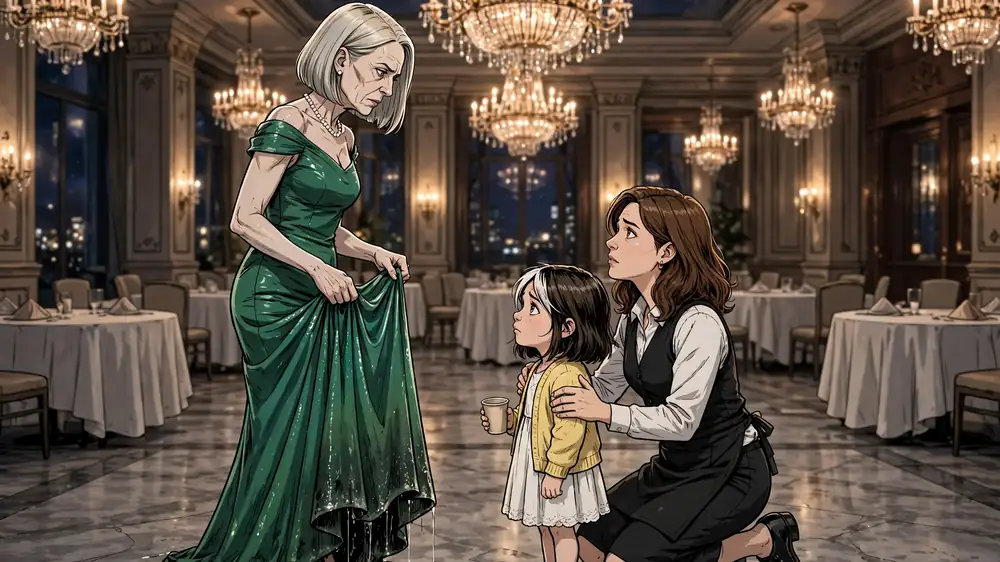
My daughter was standing in the middle of the Whitmore Harbor ballroom with an empty cup of cranberry juice in her hand, and the red was spreading down the front of an emerald-green gown that probably cost more than my car.
“Lily,” I whispered. I dropped my tray on the nearest table and ran.
I was working the Whitmore Foundation gala in a black vest and a white shirt with a name tag that said HANNAH. Catering pays sixty dollars a shift more on gala nights, and I needed every one of them. My sitter had canceled at four. My manager had said, “Keep them in the staff room and keep them quiet, or don’t come back.” So Lily and her twin brother, Leo, had been sitting on folding chairs behind the kitchen with coloring books and a bag of pretzels.
Leo was still there. Lily had gone looking for the bathroom.
“I’m sorry,” Lily was saying to the woman in green. “I’m sorry, I’m sorry.”
The woman was Margaret Whitmore. Silver-blonde bob, pearls the size of chickpeas, a face that didn’t move when she was angry. She looked down at my six-year-old the way you’d look at a stain.
“Whose child is this?” she asked the room.
“Mine.” I knelt and pulled Lily against me. “I’m so sorry, ma’am. I’ll pay for the cleaning.”
Margaret laughed. Just once. “With what, dear?”
A few people laughed with her. A tall blonde in silver sequins, the one everybody said was Grant Whitmore’s fiancée, covered her mouth with her hand.
And Grant still hadn’t turned around. He was standing ten feet away with a glass of scotch, talking to two men in tuxedos, and he’d said it over his shoulder like he was waving off a waiter.
She’s nobody.
I hadn’t heard his voice in seven years. I’d told myself I’d stopped hearing it.
“Come on, baby,” I said into Lily’s hair. “We’re going.”
“Wait.”
He’d turned. Finally. He was looking at Lily, and something in his face had gone very still.
Lily has dark-brown hair cut to her chin. Right at the front, falling over her left eyebrow, there’s a narrow streak of pure white. The kids at school call it her “skunk stripe.” Her pediatrician called it poliosis, a harmless pigment thing, usually hereditary. When she asked me where she got it, I told her it was a gift.
Grant Whitmore has the same white streak. Same side. Same width. He’s had it since he was born. So did his father. It was in every magazine photo of the two of them, the Whitmore men and their famous white lock.
He set his glass down on a passing tray without looking at it.
“How old is she?” he asked me.
The ballroom had gone quiet around us. I could feel Margaret watching me. I could feel the blonde in sequins watching him.
“Six,” I said.
“When’s her birthday?”
“That’s none of your business.”
“Hannah.” He said my name like he’d just remembered it. Like it had been sitting at the bottom of a drawer. “Hannah Cole. From the front desk.”
“Grant.” Margaret’s voice was light and pleasant. “The Lindqvists are waiting to say good night.”
He didn’t move. He was staring at Lily’s white streak, and then at his own reflection in the mirrored column beside us, and then at me.
I picked Lily up even though she’s too big to be carried, and I walked. Through the swinging kitchen doors, past the dishwashers, into the staff room where Leo sat with a green crayon in his hand and his inhaler in his lap.
“Mama, what happened?”
“We’re going home, bud.”
Leo has the white streak too. Right in the same spot.
I had both kids by the hand and was halfway out the service door into the October cold when I heard the kitchen doors bang open behind us.
“Hannah. Wait. Please.”
I didn’t turn around. “You already said what she is.”
“I didn’t know.” His breath was coming hard, like he’d run. “I didn’t see her. Hannah, I have that streak. My father had that streak.”
“I know.” I finally turned. Under the yellow light over the dumpsters, he looked exactly like he did seven years ago, and nothing like the man I’d loved. “I told you. Seven years ago, I told you, and you told your mother to handle it.”
His face went white.
“I never told her anything,” he said. “Hannah. I never knew there was anything to tell.”