
Chapter 4: The Boardroom
Grant didn’t see her in his office. He walked out past her in the hallway, said “Conference room, Mother. Ten minutes,” and kept going.
I didn’t know what he was doing until I saw who was in the conference room.
Four people in dark suits were already seated at the long walnut table. The trustees of the Whitmore Family Trust, Grant told me quietly. The trust owned fifty-one percent of Whitmore Harbor Hotels. Margaret had chaired it for nineteen years.
“I called an emergency meeting this morning,” Grant said. “Before the result. I had a feeling I’d need it either way.”
I was wearing my navy wrap dress, the only nice thing I own, and I felt like I was standing in someone else’s life.
“Why am I here?” I asked him in the doorway.
“Because she’s spent seven years telling people who you are,” he said. “Today you get to sit in the room while I tell them who she is.”
Mrs. Petrakis had the twins. I’d texted her three times on the way up in the elevator. Leo had sent back a photo of a pancake shaped like a dinosaur. I kept my phone face-up on my knee under the table, like a hand to hold.
Margaret came in with her lawyer and Sloane Ashby, and she took the chair at the head of the table like she’d been born in it.
“Grant, this is unnecessary,” she said. “I’ve told you. That woman’s children are not your children. The test was very clear.”
Grant laid the manila folder in front of her. Then the new result from Mass General, with the hospital seal and three signatures. Then a third sheet of paper.
“This,” he said, “is a statement Dr. Fenn signed at eleven o’clock this morning in my lawyer’s office. He says you told him the samples were ‘mislabeled’ and asked him to swap the child’s swab with one from his own grandson. He says you’ve paid his practice’s rent for six years.”
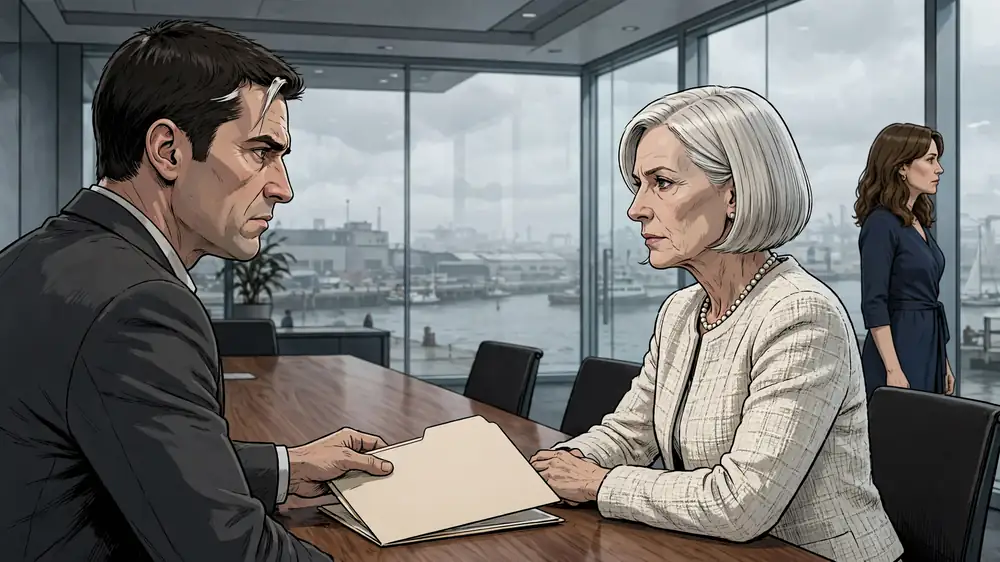
One of the trustees took off her glasses.
Margaret didn’t touch the papers. “Ronald Fenn is an old man with a drinking problem.”
“Then explain the hospital file.” Grant flipped it open to the visitor log and turned it to face her. “Seven-forty a.m. Paternal grandmother. That’s your signature, Mother. You held them. You told a pediatrician they had my hair. And then you let me believe for seven years that Hannah ran off with a bartender.”
The room was so quiet I could hear the air conditioning.
“You switched my children’s DNA test,” Grant said. “You wanted me to call them nobody. And I did.”
Sloane Ashby stood up, very carefully, picked up her handbag, and walked out without a word. Nobody stopped her.
Margaret watched her go. Then she folded her hands on the table, and something changed in her face. It got calmer. That frightened me more than anything else she’d done.
“Fine,” she said. “They’re Whitmores.”
“Yes.”
“Then they don’t belong in an apartment over a laundromat with a mother who leaves a sick child with a neighbor four nights a week.” She nodded to her lawyer, who slid a stapled document down the table toward me. “Article nine of the trust. Any minor child of a Whitmore heir is a beneficiary, and their welfare falls under the trustees until the age of eighteen. I am the chair of those trustees. This morning, while my son was busy at a hospital, I filed an emergency petition for temporary guardianship.”
The paper stopped in front of me. I could see the Massachusetts court seal. I could see Lily’s and Leo’s full names, typed.
“The hearing is tomorrow at nine,” Margaret said. She looked straight at me for the first time all day. “Then the trust will take them, Hannah. And you’ll finally get to visit.”