Chapter 4: The Toast
I drove home. Diane’s car was in the driveway. I sat behind the wheel with the shoebox on the passenger seat and didn’t go in.
Before we were engaged, she’d said. We were kids.
She’d been twenty-four, engaged fourteen months, with the invitations out. Not a kid. And it wasn’t one spring. It was two years of letters, and a man who asked her to leave me and a woman who said no but begged him to keep the secret, and then let me ask him to be my best man.
I went inside. Diane was at the kitchen table in her lavender sweater. She saw the shoebox and the color left her face all at once, like a light switching off.
“Linda,” she said.
“June sixth, 1991.” I set the box on the table, on top of the casserole lids. “You told me it ended when I came back from Columbus.”
“It did. Physically, it did. I swear on our children.”
“You told me we weren’t engaged.”
“I…” She pressed her hand to her mouth. “I was afraid if you knew it went on that long, in my head, you’d think the whole marriage was a lie. It wasn’t. Tom, I chose you. That letter is me choosing you.”
“That letter is you asking him to lie to my face at my own wedding. And he did. For thirty-five years. Every Thanksgiving. Every Fourth of July. He held my granddaughter at her baptism.”
“He wanted to tell you,” she whispered. “At the end. He told me in the hospice. He said he couldn’t die with it. That’s why I told you. I wanted you to hear it from me, not from…”
Tommy. There’s something I should’ve…
She went upstairs. I heard her moving around our bedroom, drawers opening, the closet door sliding. I didn’t know if she was packing or unpacking, and I realized I didn’t know which one I wanted. Thirty-five years, and I couldn’t predict a single thing my wife would do next. Maybe I never could.
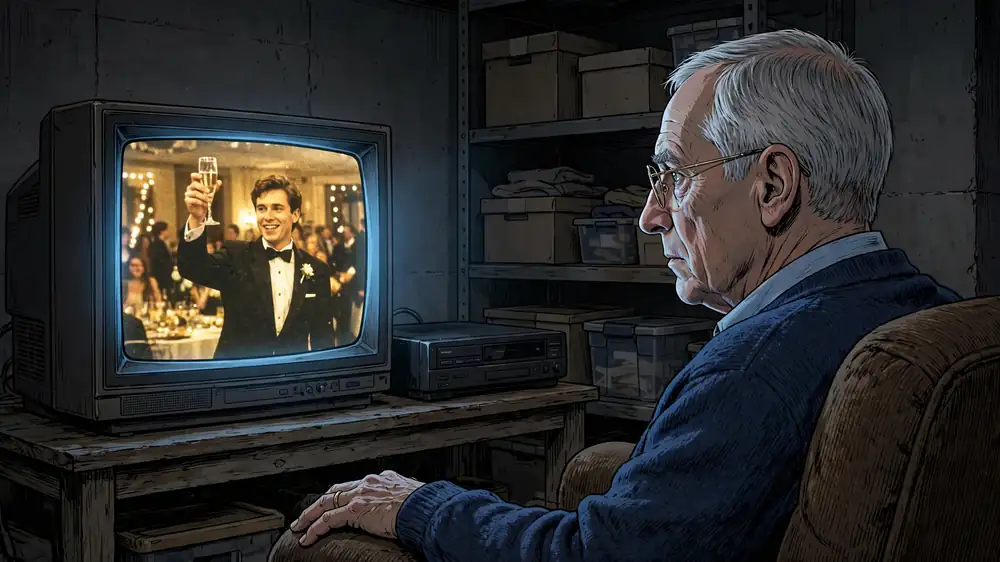
I went down to the basement. I don’t fully know why. Old men go to their basements. There’s a shelf down there with a VCR and a box of tapes I keep meaning to have digitized. Beth’s recitals. Michael’s Little League. And a white tape with a silver bell on the label, in my mother’s handwriting.
Tom & Diane. June 15, 1991.
I hadn’t watched it in twenty years. I put it in. The TV hummed and flickered, and there we were, grainy and golden, in the VFW hall with crepe paper on the ceiling. Diane in her mother’s dress, so young it hurt to look at. Me with a terrible mustache, grinning like I’d won the lottery.
And Ray, twenty-six years old, tapping a fork on his champagne glass.
I’d heard this toast at the time. I’d laughed. Everybody had.
“I’ve known Tommy since we were nine,” young Ray said on the screen. “He’s the most honest guy I’ve ever met. He’s never told a lie in his life, which is a real problem when you’re trying to get away with anything.”
The room laughed. On the tape, I laughed.
Then Ray turned and looked straight at my wife.
Diane, at the head table, didn’t laugh. She was looking down at her plate. The camera was on her for one second, maybe two, before my uncle swung it back toward Ray. I’d never noticed. Why would I have?
Ray raised his glass. His smile was a little too wide, his eyes a little too wet.
“So here’s to the luckiest man in this room,” he said. “Tom, buddy, you’ll never know how lucky you are.”