Chapter 3: Times Three
Here is what I did not do. I did not walk next door. I did not write a post in the neighborhood Facebook group. I did not scream at Sheryl Pratt across a property line she’d already crossed.
Tom used to say the loudest person in the room usually has the weakest hand.
So I made a list, the way I’d make a lab plan. Save the footage, three copies. Photograph the stump with a yardstick beside it. Keep every fine, every envelope, every email from Gus. Then find someone who knows more than I do.
It turns out there’s a kind of lawyer for this. Gloria’s grandson, who’s in law school, called it “tree law” with real reverence in his voice, like it was a religion.
Nadia Cruz’s office was in a converted bank downtown, and she had a framed cross-section of a walnut log on her wall where other lawyers hang diplomas. She was in her mid-forties, dark hair in a low ponytail, gold-rimmed glasses, and she watched the doorbell footage twice without saying a word.
When Sheryl said That’s when she’s back, Nadia paused the video and wrote something down.
“Most of my cases,” she said, “are a neighbor who trimmed a branch over the fence a little too hard. Or a contractor who cut down the wrong tree. This is not that. This is the cleanest willful timber trespass I’ve seen in fifteen years.”
“Willful,” I said.
“It matters. Under our state’s statute, if someone cuts a tree on your land without permission, you get its value. If they did it knowing they had no right, the court can triple it.” She tapped the paused screen, Sheryl mid-handshake. “She knew you were gone. She knew when you’d be back. She forged your signature so the crew wouldn’t ask questions. That’s not a mistake. That’s a plan.”
“What’s a tree worth?”
“That’s not my job.” She smiled. “That’s Walt’s.”
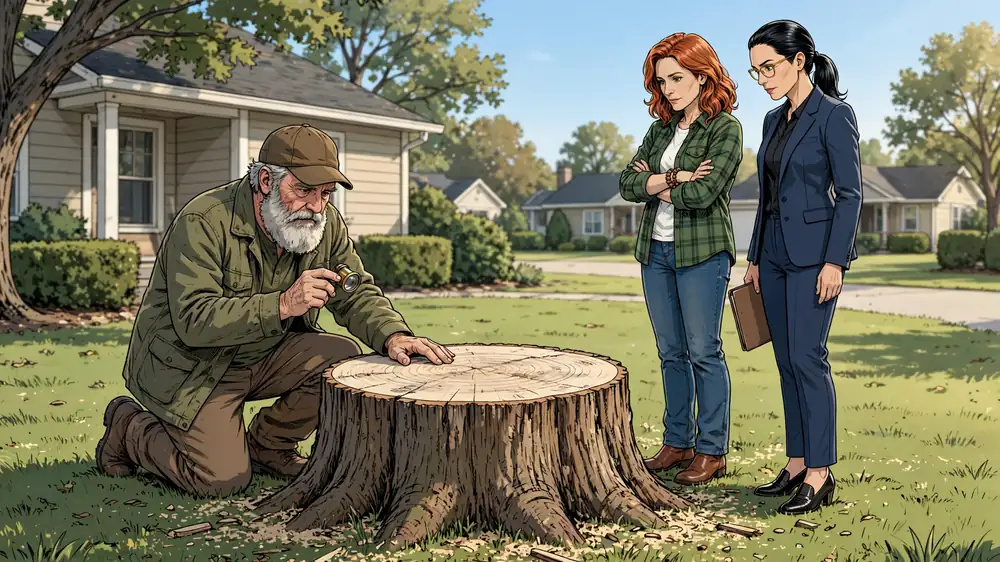
Walt Brennan came out to the house the next Saturday in an olive field jacket and a brown ball cap, with a white beard like a mall Santa who’d quit. He was a certified arborist. He’d been appraising trees for insurance companies and courts for thirty years.
He walked around the stump three times before he touched it. Then he knelt and laid his palm flat on the pale wood, and stayed like that for a while.
“White oak,” he said. “Good wood. No rot. She had another hundred years in her, easy.”
He counted rings with a magnifying loupe and a pencil for most of an hour. A hundred and four, he said. The county was right. He measured the stump, measured the root flare, took core photos, and asked me a lot of questions about shade and my energy bills and whether the tree had ever been pruned.
Then he went home and did math.
His report came eight days later. Fourteen pages. Appraised value, trunk formula method: $52,000.
Nadia read it to me over the phone. “Trebled under the statute, that’s a hundred and fifty-six thousand dollars. Plus costs. Plus whatever the forgery adds when the district attorney gets around to it.”
I sat at my kitchen table and looked out at the sky where my tree used to be.
“I don’t want to bankrupt anybody,” I said. “I want my tree back.”
“You can’t have your tree back,” Nadia said gently. “This is the closest thing the law has.”
She sent two demand letters by certified mail. One to Sheryl Pratt, personally. One to the Briar Glen Homeowners Association, because Sheryl had used an HOA work order on HOA letterhead and called herself the president to the crew. “The HOA’s insurance carrier will get involved,” Nadia said. “Officers’ policies are made for this kind of thing. Usually.”
I filed a police report about the signature. I gave Gus Keller’s lawyer a copy of my footage, because Gus had done nothing wrong except trust a clipboard.
And I waited.
For two weeks, nothing. Sheryl didn’t wave. Her pink vest didn’t appear on my sidewalk. No more fines came.
Then, on a Friday afternoon, Gloria knocked on my door with an envelope in her hand. Her face was gray.
Every mailbox in Briar Glen had gotten one.
NOTICE OF SPECIAL ASSESSMENT. HOA letterhead. Signed, Sheryl Pratt, President.
Due to a frivolous lawsuit brought by the owner of 14 Briar Glen Court, and our insurance carrier’s refusal to cover the claim, the Board has approved a special assessment of $1,400 per household, due within 30 days.
Gloria’s hands were shaking.
“Honey,” she said, “I’m on Social Security. Everybody on the street is saying this is your fault.”