
Chapter 2: The Quiet Partner
Gregory Lin has been running my company for eleven years, and in all that time I have never heard him speechless. He managed it for almost five seconds.
“Diane,” he finally said. “You’re at the Linden?”
“In the parking lot. Who booked the ballroom?”
I heard keys clicking. “The Ashford family. Celia Ashford, private event, two hundred guests.” A pause. “Ashford. Why do I know that name?”
“You tell me.”
More clicking. Then a long breath. “Ashford Development. They’ve applied to Halcyon for a forty-million-dollar bridge loan on their Stamford tower. They’re underwater, Diane. If they don’t close by Christmas, the bank takes the building. Their pitch meeting is Monday at ten.” He stopped. “With the founder. They asked specifically. I told them you never take meetings.”
I looked up at the windows of the Linden House. I’d bought it in 2009, when it was a crumbling inn with a leaking roof and a family of raccoons in the ballroom. Tom and I had stripped the wallpaper ourselves. That was the year before he got sick.
My name isn’t on the building. It isn’t on anything. The company is Halcyon Hotel Group, forty-one properties in nine states, and its founder is listed in the filings as D. M. Whitaker, a private individual who does not give interviews. I did one magazine profile in 2008, and I hated every minute of it.
After Tom died, I went back to the farm. I let Gregory run things. I wore my cardigans and grew my tomatoes and went to church on Sundays, and nobody in Harlow Falls, New York, had any idea the widow on Route 9 was worth three billion dollars.
That wasn’t an accident.
When Emily was nineteen, a boy at Cornell found out who her mother was. He proposed after four months. When I asked him, gently, to sign a prenuptial agreement, he called her a stupid little rich girl and was gone by morning. My daughter cried for a year. After that she went to New York and made her own life, and I made a decision: I would let her be loved for herself. She knew I “did something with hotels.” She thought I’d sold my share long ago. I never corrected her.
“Diane?” Gregory said. “What do you want me to do?”
“Nothing yet. Just send me the loan file.”
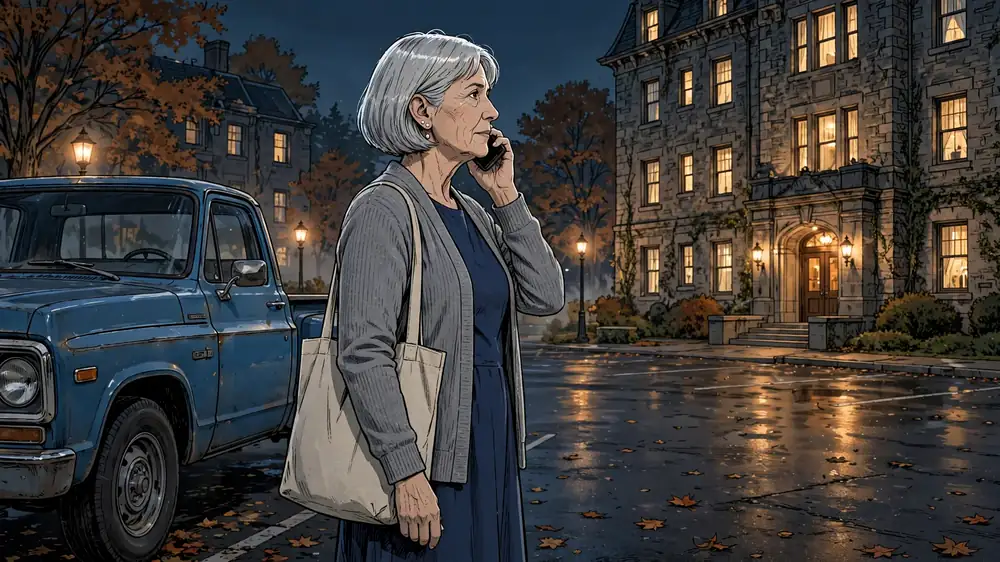
I hung up, and I walked around the side of the building, and I went in through the staff entrance.
Exactly where Celia Ashford had told me to go.
Nobody stops a gray-haired woman in a cardigan carrying a pie. I went through the kitchen, past a line cook who nodded at me, up the service stairs. The second floor has a long balcony that looks down over the ballroom. I stood in the shadow of the curtain and looked for my daughter.
I didn’t find Emily. I found Preston.
He was out on the balcony with a friend, a red-faced young man holding a glass of bourbon, and they were laughing.
“Her mom showed up in a cardigan,” the friend said. “With a pie. I’m dying.”
“Don’t,” Preston said. “She’s useful.”
“Useful how?”
Preston leaned on the rail. “The old lady’s sitting on three hundred acres upstate. Lakefront. Do you know what a developer could do with that?” He took a sip. “After the wedding, her mother’s farm goes in our trust. Emily already agreed to put it in the paperwork. She thinks it’s for estate planning.”
The friend whistled. “And the mom?”
“Assisted living in five years, tops. We’ll find her a nice one.”
I took out my phone. I’m not a young woman, but I know how to press a red button, and I’d been recording since the word useful.
I went back down the service stairs very slowly, because my hands were shaking, and I stepped out into the ballroom just as the music stopped.
Celia Ashford was standing by the coat check, one hand pressed to her bare wrist. Her voice rang across the room.
“My bracelet,” she said. “My diamond bracelet is gone. I took it off for one minute.”
Then she turned, and she found me, and she pointed.
“That woman,” she said. “The one in the cardigan. She was right here. Check her bag.”
Two hundred faces turned toward me.
And at the top of the grand staircase, in a blush-pink dress, my daughter stopped and stared.