Chapter 3: Personal Effects
I didn’t drop my fork. I’m proud of that.
“That’s beautiful,” I said. “Is it old?”
Brooke turned her wrist so the charms caught the light. “Grant gave it to me. It was his late wife’s.” She said it the way you’d mention a car you’d traded in. “He said it was a shame to keep it in a drawer.”
A drawer.
Not a casket. A drawer.
“Generous man,” I said.
“He has his moments.” She stood, squeezed my shoulder, and moved on to the next table, and I sat there with the taste of metal in my mouth.
Theo was waiting in the hotel garage. I got in, shut the door, and said, “The bracelet was never in the casket.”
He didn’t ask how I knew. He just started the engine and said, “Then let’s find out what was.”
It took him nine days and a records request with three of his old friends behind it. When he brought the file to my apartment, he set it on the kitchen table and didn’t open it. He let me do that.
Medical Examiner’s Report. Columbia County. Decedent: Laura Anne Holloway (identified).
Identification method: Visual, by spouse. Supported by sworn affidavit of spouse regarding prior healed fracture, left wrist.
I read the line twice.
“Theo,” I said. “I’ve never broken a bone in my life.”
“I know. I pulled your pediatric records.” He tapped the page. “DNA was sent to the state lab. Results came back inconclusive because of the water. Normally they’d try again. But the husband had an affidavit and a funeral home waiting, and the county had a backlog. So they closed it.”
“He lied under oath.”
“He lied under oath,” Theo agreed. “About a dead woman. Which means he either thought it was you and wanted to be sure, or he knew it wasn’t and wanted it over.”
I sat back. The kitchen was very quiet. Somewhere below us a bus sighed at a stop.
“Who is she?” I asked. “The woman in my grave.”
Theo pulled one more sheet from the back of the folder. A missing-person poster, faded, from a shelter in Longview, Washington. A woman with long brown hair and a crooked, shy smile.
Joanna Pike, 39. Last seen November 18.
Three days after my car went into the river.
“Her sister Marcy still posts this every year,” Theo said. “She thinks Joanna’s alive somewhere. Nobody ever told her to look in a grave with your name on it.”
I put my hand flat on that poster and didn’t say anything for a long time.
Then I went back to work.
As chair, I could open any door at Holloway Development, and I opened all of them. I hired forensic accountants. I froze two bank accounts and asked a lot of polite, boring questions with very sharp edges. I watched the Riverside money move through three shell companies and land, eventually, in an LLC whose manager was B. Sinclair.
Brooke’s maiden name.
Grant, meanwhile, started showing up.
At my office door with coffee I hadn’t asked for. At the end of meetings, lingering. One night he stayed after everyone left and stood at the window beside me, looking at the river.
“You remind me of someone,” he said. “I keep thinking that. It’s not your face. It’s the way you stand when you’re angry. Like you’re bracing for weather.”
“Was she angry often?”
“No.” He was quiet. “She should have been.”
I almost said it then. I almost turned and said, Grant, it’s me. Not out of love. Out of exhaustion.
Instead, I said, “Goodnight, Mr. Holloway.”
I wasn’t careful enough with Brooke.
I’d been sketching in meetings, the way I always had. Tiny houses in the margins, three windows and a crooked chimney. A habit since architecture school. I’d stopped it for three years. I’d started again without noticing.
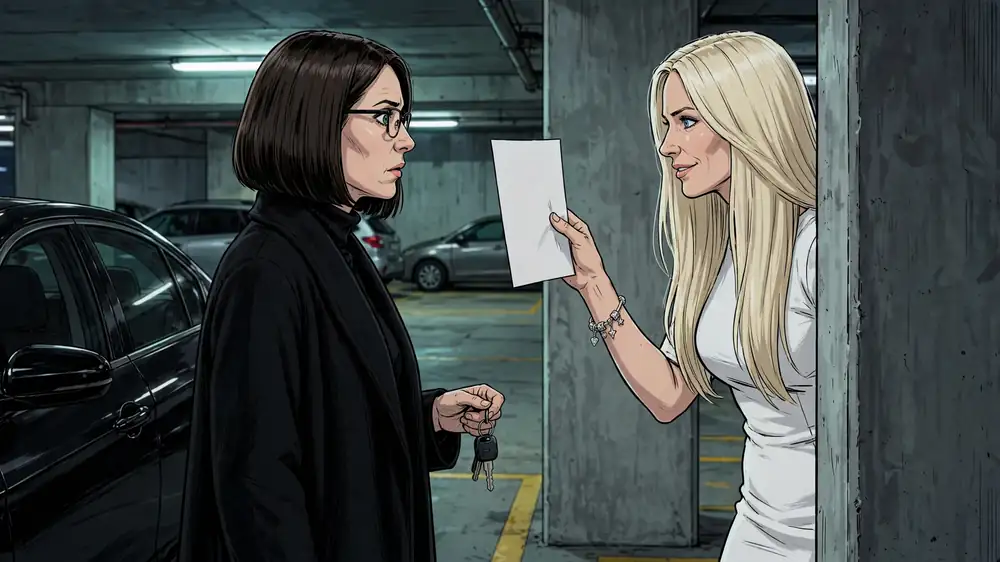
On Friday night, my heels echoed through the parking garage under the Holloway building. My car was on level three. I had my keys out.
A shape stepped from behind a concrete pillar.
Brooke held up a sheet of paper. My meeting notes. Three tiny houses in the margin, three windows, one crooked chimney.
“Grant has a box of her old sketchbooks in the garage,” she said softly. “I went through them last night.”
She smiled.
“Hello, Laura. You look good for a dead woman.”