Chapter 3: The Cedar Chest
Jo made me eat toast before she’d let me call a lawyer.
“You need a family lawyer by noon,” she said. “And you need to understand something. The fastest way to beat ‘no income’ is to show the judge your income.”
“Which means telling the court I’m R.J. Lark.”
“Which means telling Douglas.”
I looked out at the lake. A heron stood in the shallows, perfectly still, the way I had stood in that dark hallway.
For eleven years, R.J. Lark was the only thing I had that the Carters couldn’t touch. Not my clothes, which Constance criticized. Not my friends, who slowly stopped being invited. Not my time. Lark was mine. The second Douglas knew, he’d look at her the way he looked at a property.
“Give me one day,” I said.
Maisie came that afternoon. She rode her bike forty minutes on the shoulder of Route 12, which I’m going to have a conversation with her about for the rest of her life.
She dropped the bike in the grass and ran up the steps and hugged me so hard we nearly went over the porch rail.
“Dad says you had a breakdown,” she said into my sweater. “Grandma says you’re having one of your moods.“
“I’m not having a breakdown, honey. I’m having a break.”
She wiped her face and looked around the cottage. She’d been here a hundred times, but always for swimming, never inside the back room. Today the back room door was open.
Before I could stop her, she walked in.
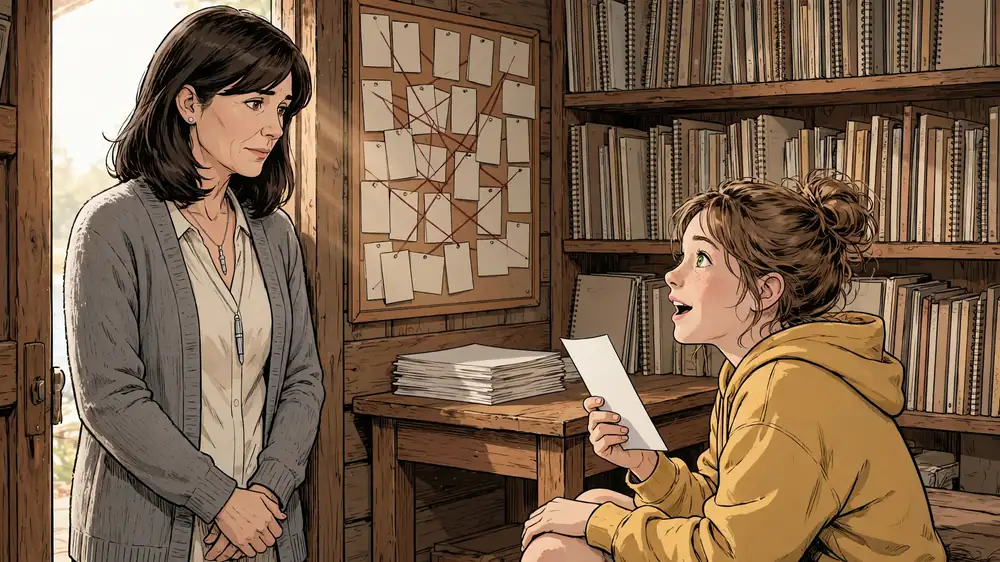
The shelves were floor to ceiling. Spiral notebooks, dozens of them, dated in my handwriting. A corkboard full of index cards with names and arrows. And a stack of printed pages on the desk, with a title on top in big black type.
The Lantern House, Book Ten. Draft 3. R.J. Lark.
Maisie picked up the first page. She read it. Then she turned and looked at me in the doorway, and I watched her put it together, the way a good reader does, all the clues falling into place at once.
The green ribbon on Grandma’s present. My “book club” weekends. The way I always knew who the killer was by chapter four.
“Mom,” she said. “Mom. You’re R.J. Lark?”
“Yes.”
“I have every single one of your books. I did my eighth-grade report on The Lantern House. I got a B-plus!” Her voice cracked. “Why didn’t you tell me?”
I sat on the floor among the notebooks, and she sat with me.
“Because in that house,” I said, “anything I had that was mine, they found a way to take or laugh at. I didn’t want them laughing at this. And I’m sorry, Maisie. You weren’t them. I should’ve known the difference.”
She leaned her head on my shoulder. She didn’t say it was okay. She just stayed there.
After a while she said, “In book six. The mother who hides the letters in the piano. Is that you?”
“A little.”
“And the daughter who finds them?”
“That one,” I said, “was always you.”
She laughed and cried at the same time, which is a thing only fifteen-year-olds and novelists can do without embarrassment.
Her phone buzzed. Then again. Then a third time. She looked at it, and every bit of color left her face.
“It’s Aunt Patty. She’s at our house.” She turned the screen so I could see the photo. “Mom. Dad’s in your sewing room with a locksmith.”
In the photo, my cedar chest stood open. The one from my grandmother. The one where I kept the first notebooks of all nine books and eleven years of royalty statements in a folder marked Recipes.
Douglas was holding the folder.
“He knows,” I said.