Chapter 1: The Veil
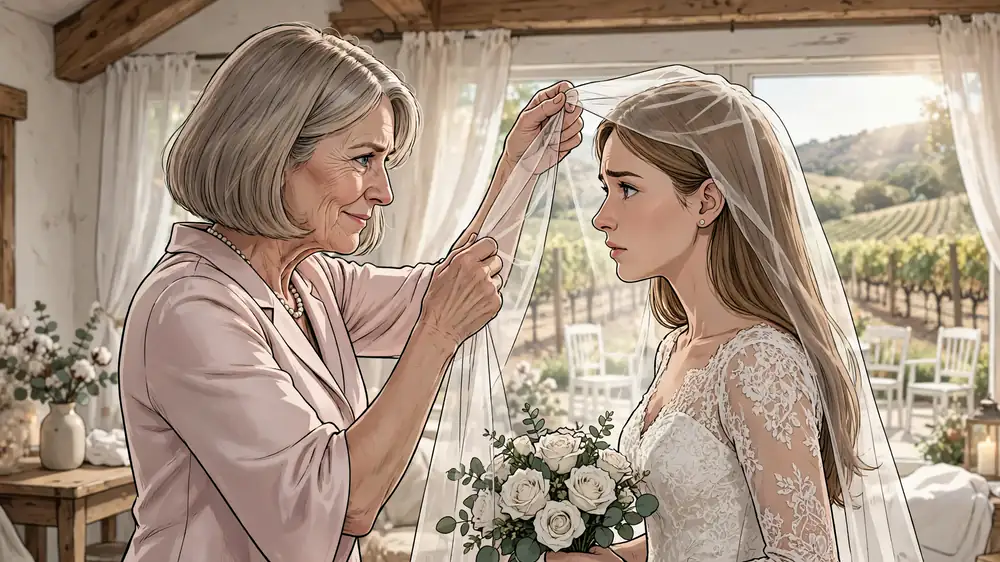
“Keep the veil down until you’ve signed,” my mother said, and stabbed another pin into my hair.
The dress was my sister’s. Ivory lace, a cathedral train, a bodice altered for a woman with a smaller ribcage and better posture than mine. Every time I breathed, a seam on my left side made a small, warning sound.
“Mom. He’s going to know.”
“He’s going to know when it’s legal,” Patricia Marlowe said. She tugged the veil forward so the whole world went soft and white. “Not one minute before.”
Outside the window of the bridal cottage, two hundred and forty guests were taking their seats between the rows of vines at Marlowe Estate. There was a string quartet. There was a cake with sugar grapes on it that had cost more than my car. There was a groom named Julian Kade, who ran Kade Capital and was worth, according to Forbes, a little over two billion dollars.
And there was no bride.
My sister Celeste had been gone since six that morning. Her bed was made. Her car was missing. On her pillow there was a sheet of hotel notepaper with five words on it in her slanting handwriting.
I’m sorry. Don’t look for me.
My father had read it, folded it into his blazer pocket, and called me into his study.
I’m the younger one. Celeste was the one they planned for: the riding lessons, the Stanford degree, the face on the Marlowe Estate website pouring a glass of cabernet in the sunset. I was the one who drove the forklift in the barrel room during harvest and did the books for the tasting room and didn’t need anything. When I was sixteen, I heard my mother tell a friend on the phone, “Oh, Tessa’s our spare. Every family needs one.”
“Kade’s investment closes on the marriage,” my father had told me in the study, very calm, swirling his coffee like it was wine. “Forty million dollars, Tessa. Released the day the license is signed. Without it, the bank takes the estate in ninety days. Your mother’s house. Your job. Everything.”
“Then tell him the truth. Ask him to wait.”
“Men like Julian Kade don’t wait.” He’d looked at me the way he looks at a vintage he isn’t sure about. “You’re the same height. Same build, more or less. With the veil down and the light behind you, nobody will look twice. Nobody ever does.”
He hadn’t meant it cruelly. That was the worst part. He’d meant it as a fact.
So now I was standing at the end of an aisle made of rose petals, holding my sister’s bouquet, with my father’s hand clamped on my elbow.
The quartet started. Every head turned.
I walked. I couldn’t feel my feet. Through the lace, everything was haze and sunlight, and at the end of the haze stood a tall man in a black tuxedo with his hands folded in front of him.
I’d met Julian Kade exactly twice. At the engagement party, where he’d spent most of the night talking to Celeste on the terrace with their heads close together. And at the rehearsal dinner last night, where he’d looked across the table at me for a long moment while my father was giving a toast, and I’d looked away first.
My father let go of my elbow and gave my hand to him.
Julian’s fingers closed around mine. Warm. Steady. He didn’t squeeze, and he didn’t flinch.
The officiant opened his leather book. He was a retired judge, a friend of my father’s from the club.
“Dearly beloved,” he began, and then he stopped, and frowned at the marriage license tucked into the front of the book. He adjusted his glasses. He looked at my father in the front row.
“I’m sorry,” he said. “There seems to be some confusion. The license here has been filed in the name of Julian Andrew Kade and…” He leaned closer to the page. “Tessa Anne Marlowe.”
The guests murmured. My mother made a sound like a teacup breaking.
I couldn’t breathe. Through the veil, I looked up at the man holding my hand.
Julian Kade lifted the edge of the lace with two fingers, just enough for me to see his face and for him to see mine.
He wasn’t surprised. Not even a little.
“Hello, Tessa,” he said quietly. Then he turned to the judge. “No confusion. Please go on.”