Chapter 2: The Letters With Red Windows
My father, Gene Hollis, worked thirty-one years at the tire plant in Akron and bought our house on Delmore Street in 1987 for sixty-four thousand dollars. He painted it himself every seven years. Same color every time, a pale gray he called “battleship.”
Travis was the one Dad worried about. He always had been.
Travis was the boy who could sell anything, and the man who never kept anything he bought. A bar in Cuyahoga Falls that lasted fourteen months. A food truck that lasted six. A bass boat. Two credit cards in Dad’s name that Dad didn’t find out about until a collector called the house.
I was the one Dad didn’t worry about. I’m a dental hygienist. I drive a ten-year-old Camry. I’ve had the same savings account since I was nineteen, and I put money into it every other Friday whether I feel like it or not.
When Dad’s hands started shaking in 2020, it was me who drove him to the neurologist. When he couldn’t drive anymore, it was me who drove forty minutes each way after work, every night, to make sure he’d eaten and taken his pills. Travis called on birthdays. Sometimes.
The letters from the bank started that winter.
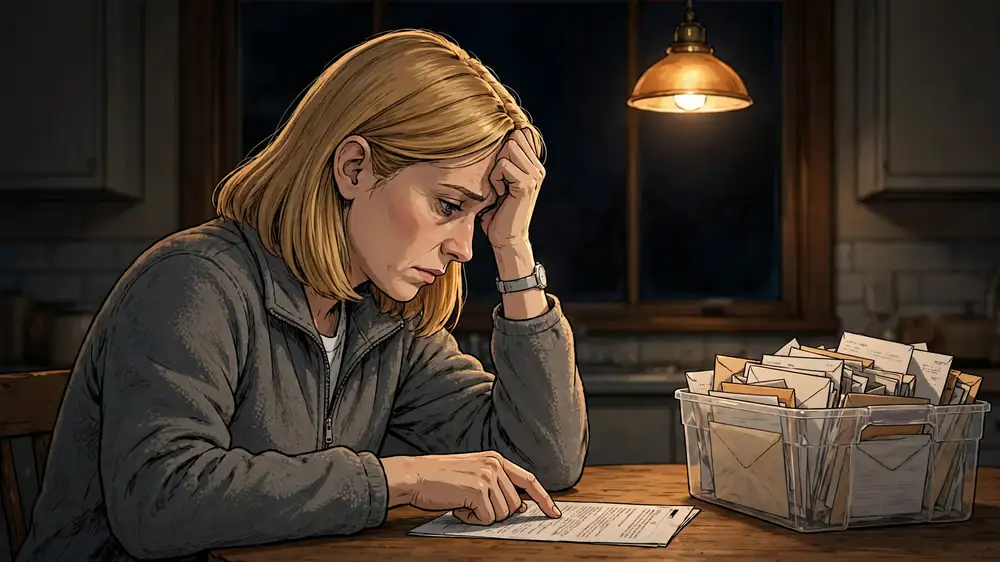
Dad hid them. I found them in the bread drawer, in his tackle box, in the pocket of his good coat. Envelopes with red windows. Notice of Default. Notice of Acceleration. By the time I sat him down at the kitchen table and spread them out, he was eight months behind on a loan I didn’t know existed.
“It’s a second mortgage,” he said, and wouldn’t look at me. “It’s handled.”
It wasn’t handled. In March of 2022, the house on Delmore Street was sold at a sheriff’s auction on the courthouse steps. Nobody bid on it. It went back to the bank.
I was the only one who knew. I made sure of it.
What I did next, I’ve never told anyone but my lawyer and my bank.
I called the bank’s real estate office and asked what they wanted for it. They wanted two hundred and eight thousand dollars, which was what it was worth. I had sixty-one thousand in that savings account I’d started at nineteen. I cashed out part of my retirement. I signed a thirty-year mortgage in my own name, at my own rate, with my own credit. On June ninth, 2022, the deed to my father’s house was recorded with Summit County in one name.
Mine.
I moved in that week. I moved Dad from his bedroom downstairs into the den, because he couldn’t do the stairs anymore. I put in grab bars and a ramp. I replaced the furnace and the roof and every window, because the bank had let the place sit empty through a winter and the pipes had split.
Dad never understood that it was mine. Or maybe he did and decided not to. Some mornings he’d look around the kitchen and say, “Your mother would like these cabinets,” and I’d say, “I think so too.”
Once, near the end, he grabbed my wrist with his shaking hand.
“Don’t tell your brother,” he said. “Whatever happened with the house. He’ll think it was his fault.”
I didn’t understand what he meant. I thought he was confused. I promised.
He died eighteen months after I bought the house, in the den, at four in the morning, with the porch light on because he liked to see it through the curtains. Travis came to the funeral in a borrowed tie. He got thirty thousand dollars from Dad’s life insurance, the same as me. Within the year, he’d spent it on a new truck and a trip to Las Vegas.
He never once asked about the house. I assumed he’d forgotten it.
He hadn’t forgotten. He’d been waiting.
The Monday after the U-Haul, I couldn’t sleep. At two in the morning I went down to the basement and opened the plastic bin where I’d kept every one of Dad’s red-window letters, plus the loan file I’d requested from the bank when I bought the house. I’d never read the whole file. I’d never wanted to.
I read it that night.
The second mortgage was taken out in August of 2019. Ninety thousand dollars. There was a disbursement sheet on page fourteen, showing where the money went.
It didn’t go to Dad.
It went in one wire, that same afternoon, to an account at a bank in Cuyahoga Falls, to pay off a judgment and three overdue loans.
The account holder’s name was Travis E. Hollis.