Chapter 1: Number of Guests
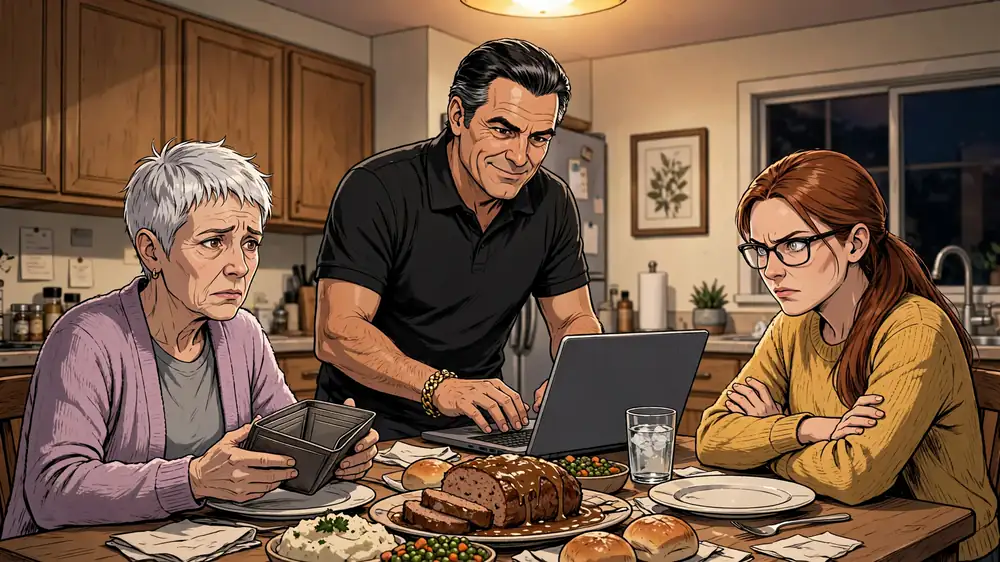
“Fifteen days, Mo.” Tom brought his palm down on the kitchen table hard enough to make the salt shaker jump. “After twenty years, I’ve earned fifteen days.”
It was the fourth month of this. I’d started counting the fights the way I used to count chemo rounds. Fight number one was in June, over a TV ad for a Georgia peach festival. Fight number thirty-something was tonight, over meat loaf.
Our daughter, Kelsey, sat across from me with her fork in midair. She’d driven over from Dublin because I’d asked her to come for dinner. I hadn’t said why. I didn’t have to.
“Nobody’s saying you haven’t earned it,” I said.
“You’re saying it with your face.”
I rearranged my face. I’ve had a lot of practice.
Tom wants to go home. That’s how he says it: home. As if the split-level in Westerville, Ohio, where we’ve paid the mortgage for twenty years, is a motel he got stuck in. Home is Harlan Creek, Georgia, population four thousand, where his mama still lives in the house with the green shutters and his brothers still fish off the same dock. He hasn’t been back in eleven years. Then, this summer, he suddenly couldn’t breathe without it.
“Mama’s turning eighty,” he said. “You want me to miss that? You want her to die without seeing her son?”
“Of course not.”
“Then what’s the problem?”
The problem was fifteen days. The problem was that he wanted to go alone. The problem was that his mother’s birthday is in March, and it was September.
“Dad,” Kelsey said carefully, “Mom has her six-month scan on the twentieth. That’s the week you’d be gone.”
Tom didn’t even look at her. “Her scans don’t need me.”
That one landed somewhere under my ribs.
Fourteen months ago I finished my last round of radiation. Before that came four rounds of chemo, a lumpectomy, and a winter I mostly remember as the ceiling of our bedroom. My hair grew back silver and short, like a little boy’s. I take a pill every morning that keeps the cancer from coming back and takes a few other things with it. My energy. My sleep. The part of me that used to reach for my husband in the dark.
Tom has never once said the word cancer. He says “your thing.”
“I drove you to every single chemo,” he said now, leaning across the table. “Every one, Mo. I sat in that waiting room with the fish tank for a year of my life. You owe me.”
Kelsey set her fork down. “She owes you?”
“Stay out of it, Kels.”
“She’s my mother.”
“And I’m the one who raised you,” Tom said, “so watch your tone.”
Kelsey’s jaw set. She was two when her real father walked out on us and six when I married Tom. He taught her to ride a bike. He’s the only dad she’s ever known, and right then she looked at him like a stranger.
I knew how this would go if I pushed. I’d been married once before, at twenty-three. Gary left me for a woman from his office when Kelsey was still in diapers, and I spent five years eating cereal for dinner and crying in a Kroger parking lot. I swore I would never be that woman again.
I’m fifty-two now. I have a port scar under my collarbone and a pill organizer with the days of the week on it. Who exactly did I think would want me?
So I did what I always do.
I got up, took my purse off the hook by the door, and pulled out my credit card. The one in my name. The one connected to the money my mother left me.
Kelsey said, “Mom.”
I handed it to him anyway.
Tom was already pulling my laptop across the table, already smiling, the big Sunday-showroom smile that sold a lot of Buicks back when people still bought Buicks. He typed fast. A flight from Columbus to Savannah. A rental car. And then a beach house on Tybee Island, forty minutes from his mama’s.
“Why do you need a beach house,” Kelsey asked, “if you’re going to see Grandma Delaney?”
“Because Mama’s house has one bathroom and four brothers.” He hit the last key. “Booked. Tybee beach house, fifteen nights.”
He spun the laptop around so I could see the confirmation, like a boy showing off a report card.
Fifteen nights. Oceanfront. A total that made my stomach turn over.
And under it, in neat gray letters:
Number of guests: 2.