
Chapter 1: K. Brandt
“Eighteen thousand, six hundred dollars, Derek.”
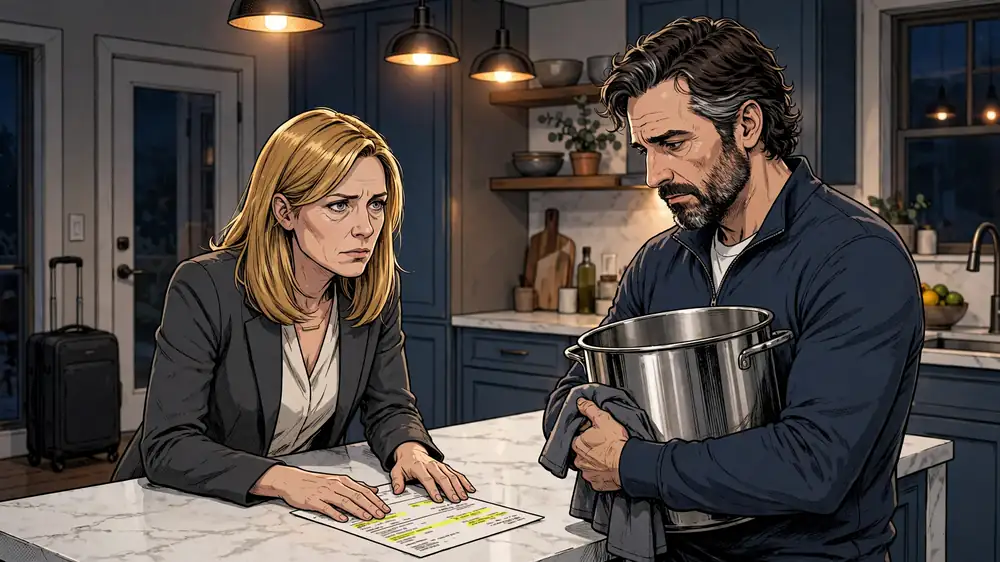
I said it calmly. I’d practiced in the car. I laid the bank statement on the kitchen island between us and smoothed it flat with both hands, the way I lay out a contract for a hospital buyer who’s about to sign something they haven’t read.
Eleven lines were highlighted in yellow. Same payee every time.
Zelle to K. BRANDT. Memo: lessons.
Derek was holding a dish towel. He’d been drying the big pasta pot when I came in, and he kept drying it, slower now, turning it in his hands.
“It’s pickleball,” he said. “I told you I was taking lessons.”
“You told me you were taking lessons from a guy named Ken at the rec center. For forty dollars a session.”
“Kayla’s better. She charges more.”
“She charges seventeen hundred dollars a month?”
He set the pot down. Upstairs, I could hear Maddie’s music through the ceiling, that thudding bass she swears is quiet. Owen was in the den with his headphones on. It was 9:40 on a Wednesday night in March, and I’d just gotten home from a three-day sales conference in Phoenix, and my rolling bag was still standing by the back door like it was waiting to see if it needed to leave again.
I wouldn’t have seen the statement at all if the bank hadn’t sent me an alert. Unusual activity on a joint account. I’m the one who set up the alerts, ten years ago. I’d forgotten they existed. I’m not proud of that.
Here’s what you need to know about our marriage. I make the money.
I’m a regional sales director for a company that makes surgical robots. Last year, with bonus, I earned a little over three hundred and forty thousand dollars. Derek used to coach varsity baseball at a high school in Elk Grove. Nine years ago, when Owen was four and I got the promotion that meant flying three days a week, we sat at this same island and decided together that he’d stay home.
I remember being grateful. I remember saying, You’re giving me this. I won’t forget it.
He handled the pickups, the dentist, the science fairs. I handled the mortgage, the college funds, the retirement accounts. I moved money every month from my paycheck into the joint account so he’d never have to ask me for anything.
I thought that was respect.
“Who is K. Brandt?” I said.
He looked at the ceiling, toward Maddie’s music.
“Can we not do this with the kids home?”
“The kids have headphones on. Who is she?”
“She’s a coach at the club. We got close. It’s not…” He stopped and started over. “Claire, you’re gone half the week. You come home and you’re on your laptop until midnight. I’m not saying that makes it okay.”
“Then what are you saying?”
“I’m saying it didn’t come from nowhere.”
I looked at him across the island, the man who’d taught our son to ride a bike, and tried to find the part of me that was surprised. It wasn’t there. What was there was colder, and I didn’t like it.
“How long?”
“Since last spring.”
A year. The statement said eleven months. The math checked out. Of course it did. I always check the math.
“Okay,” I said. “Then I think we both know what happens now.”
I expected him to argue. To beg, maybe, or to cry, the way he cried at Maddie’s eighth-grade graduation. Derek cries at commercials.
Instead he folded the dish towel in thirds and laid it over the oven handle, neatly, the way he always does.
“Before you say anything else,” he said, “you should know I talked to a lawyer last week.”
The bass upstairs kept thudding.
“Last week,” I said. “Before I saw this.”
“I knew you’d see it eventually.” He didn’t look smug. That was the worst part. He looked tired and careful, like a man reading a script he’d already rehearsed. “She said I shouldn’t discuss money with you directly anymore. So I’m going to go upstairs now.”
He walked past me. He stopped at my rolling bag by the door, and for one strange second I thought he was going to carry it up for me, the way he used to.
He stepped around it.